


TANGLES Review
- Dan + Julia Reyes
- 16 hours ago
- 3 min read


We reached for each other's hand about twenty minutes into Tangles. Not dramatically, not consciously. Just the quiet, involuntary reach of two people sitting in the dark who have both known what it is to watch someone they love begin, very slowly, to go somewhere they cannot follow.
Tangles, the fourth film of our third day at Cannes and the eleventh of the festival, is that kind of film. The kind that finds you where you actually live and does not apologize for it.
Leah Nelson's debut feature adapts cartoonist Sarah Leavitt's autobiographical graphic novel about her mother's early-onset Alzheimer's, and it does so with a fidelity to the source material's visual and emotional singularity that is itself a kind of love. The animation is executed mostly in sharp monochrome, with sporadic eruptions of violet and magenta marking core memories and surges of feeling. It is not decorative. The film earns its medium completely. This is a story about a person who draws her emotions more clearly than she speaks them, and the drawn line has a directness that live action could not replicate without losing something essential.
The color returns only for memory and for love. Everything else is rendered in the grey of getting through the day. That is the most honest thing the film does, and it does it from the very first frame.
The story splits its attention between two lives running in parallel: Sarah in San Francisco, young and queer and finding herself inside a vibrant community and an unexpected love affair with a cool, Zen motorcyclist named Donimo; and Sarah in Maine, making the increasingly difficult trips home to parents who raised her with a generosity and openness that the film renders with genuine warmth, watching her mother, Midge, begin to slip. The film holds both of these lives with equal care, which is one of its great strengths. The joy in San Francisco is not decoration for the grief in Maine. They are the same life, and the distance between them is part of what makes the loss so particular.
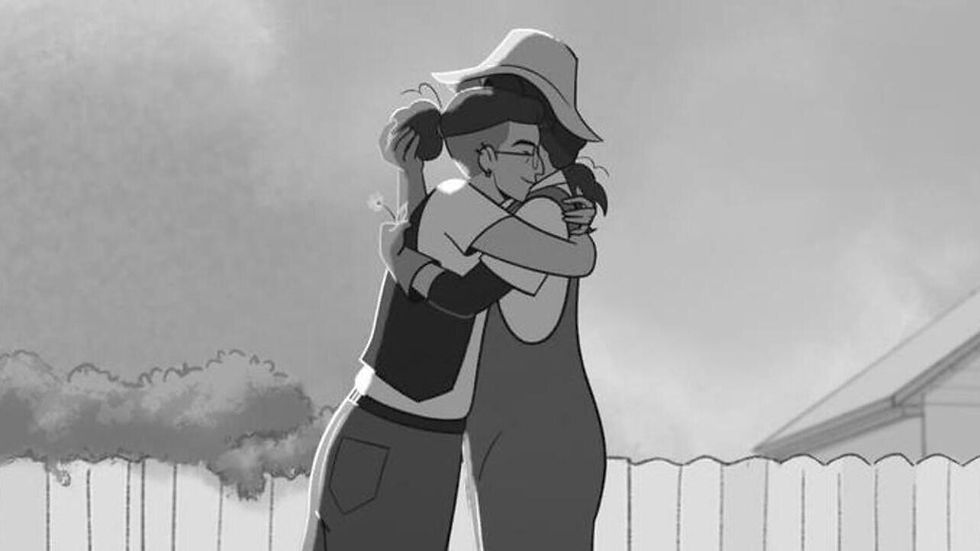
Julia Louis-Dreyfus voices Midge across the full arc of the disease with a precision and a grace that we did not entirely anticipate. She finds Midge in all her sliding states of consciousness, from the bright and empathetic woman of Sarah's childhood memories to the fragile, furious person railing against a deterioration she cannot halt, to the foggy echo who sometimes recognizes the love surrounding her and sometimes does not. It is a performance that asks its actor to slowly, carefully disappear, and Louis-Dreyfus does it without a single false note.
Alzheimer's is not just a loss of memory. It is a loss of the person who held your memories of yourself. The film understands this and never lets you forget it.
Abbi Jacobson carries the film as Sarah with a performance that is loose and funny and then quietly devastating as the weight accumulates. The film has the idiosyncratic humor of the source material, the dark wit of a person who has learned that grief and laughter are not opposites but close neighbors, and Jacobson navigates that tonal range with real skill. The queer subplot, Sarah's relationship with Donimo and the life she has built in San Francisco, is not a relief valve from the heavier material but a full and necessary strand of the same story. This is what it is to be a person and also a child, to be falling in love in one city while someone you love is falling away in another.
We walked out holding hands still. The Cannes evening was warm and the crowds were loud, and neither of us felt quite ready to rejoin them. That is the highest compliment we know how to give a film about loss. It made the world outside feel briefly, tenderly, very precious.
🍿 SCORE = 85/100


Comments