


THE MELTDOWN Review
- Dan + Julia Reyes
- 1 day ago
- 3 min read


There is a particular kind of political cinema that trusts its audience to feel the weight of history without being told what that history was. Manuela Martelli's Chile '76 was that kind of film, and so is The Meltdown, her tense and quietly devastating follow-up. We are in 1992. Pinochet has been voted out. Democracy has been formally restored. A child named Ines is spending time at her grandparents' Andean ski resort, and a teenage girl has disappeared, and everyone around her would very much prefer that the question of what happened be left unanswered. The snow is white and the sky is white and the past, as always, is buried somewhere underneath both.
The film opens with grainy camcorder footage of an actual iceberg, carved from Antartica and shipped to the Universal Exposition of Seville in 1992 as a symbol of Chile's hard-won modernity. It began to melt before it even arrived. Only the submerged mass, invisible to the naked eye, remained intact. Martelli uses this as her central image and her central argument: a nation cannot separate its gleaming present from the dark and unmovable mass of what it did to get there. The iceberg is a perfect metaphor and she knows it, which is both the film's greatest strength and, occasionally, its greatest temptation.
The power and the clouds are both an identical shade of white. The earth and sky blend so perfectly that it seems impossible to imagine anything exists beyond what the eye can see. That is precisely the point.
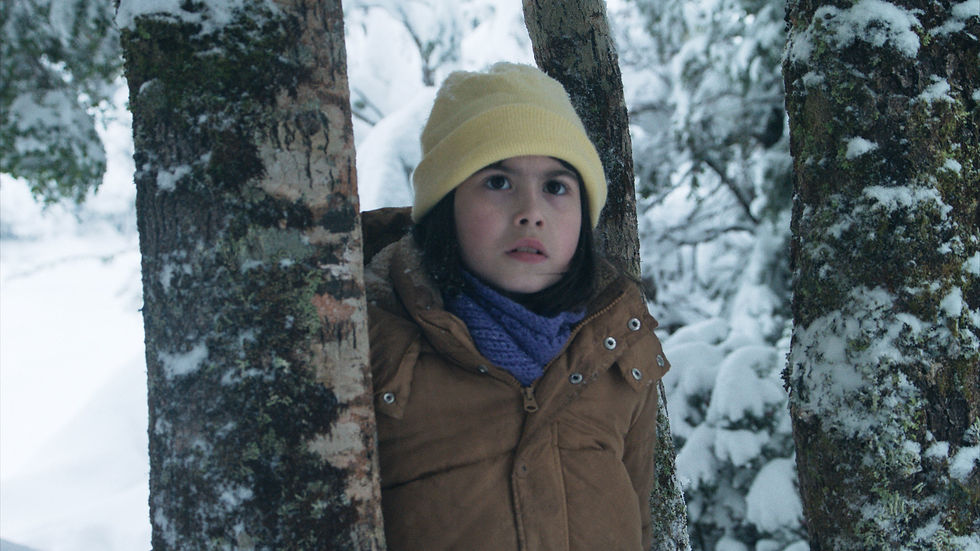
Maya O'Rourke plays Ines with a watchful, compellingly uncertain stillness, a nine-year-old who has grown up in a world of strange ellipses, where adults go quiet when certain names are mentioned and questions are answered with the silence rather than lies. She is old enough to notice. She is not yet old enough to name what she is noticing. The film sees the world entirely through her eyes, which gives it a skeptical naivete that makes even the most ordinary adult interactions feel faintly conspiratorial. In a country still learning to breathe after decades of authoritarian terror, perhaps they are.
The missing girl, Hannah, is a 15-year-old German ski prodigy who follows the snow around the globe all year, rootless and radiant. Her disappearance from the resort is handled not as a crisis but as an inconvenience, hushed by Ines' grandmother whose primary concern is the resort's expansion and the foreign tourists she wants to attract. The film understands that this is not merely selfishness. It is a worldview. A whole country has agreed, quietly and collectively, that a certain amount of forgetting is the price of moving forward. Ines has absorbed that agreement without ever being told about it.
Hannah's mother arrives from Germany wild-eyed and utterly unwilling to let it go. She is the only person in the film who has not agreed to forget. The film comes most alive in her presence.
Saska Rosendahl plays Lina, the mother, with a ferocity that cuts through the film's careful opacity like something hot through ice. The tender, tentative friendship that forms between Lina and Ines, a daughter who needs a mother and a mother who needs a daughter, is the film's most quietly moving strand and the place where Martelli's political argument and her human instincts meet most naturally.
Where the film loses its footing is in the fidelity to Ines' passivity. Children stress test their realities constantly and fiercely, and the decision to keep Ines largely still and observational eventually slows the film's momentum to a point where even the thriller mechanics begin to feel like they are happening at a remove. Martelli is enamored with her own opacity, and the mystery at the center of the film is ultimately left to resolve itself rather than earned through the accumulation of pressure and consequence. The past never goes away, the film tells us. We believe it. We just wished the film had forced us to feel it with a little more urgency.
Still. We walked out of our second film of day three thinking about icebergs and what they hide, about countries that ship their traumas to world expos and hope the sun does not reach them in time.
The Meltdown is an imperfect film with a perfect central image, and that image stayed with us longer than the plot. That, in its own way, is enough.
🍿 SCORE = 64/100


Comments