


TOP 5 STEVEN SPIELBERG FILMS


Just in time for his latest film, Disclosure Day, I figured it was time to look back at this Academy Award-winning filmmaker's work. Steven Spielberg has become an influential filmmaker for many bright storytellers, including Paul Thomas Anderson, Sean Baker, Peter Jackson, and Jordan Peele. He's certainly a talented filmmaker, even if he's made some underwhelming films in the past; one of which I've noted in the past on this site. But I'd argue his batting average has been more positive than negative, which is what I'm hear to discuss.
I should also point out that while my Cannes' Top 5 lineup was tough, this was even tougher to nail down as there are too many great films Steven has made over the years, including his more recent outings. To save time, I'll just list off some honorable mentions:
Minority Report (2002)
Jaws (1975)
West Side Story (2021)
Indiana Jones and the Last Crusade (1989)
With that out of the way, let's get started with my Top 5 list!
5) E.T. the Extra-Terrestrial (1982)

Plot Summary via Letterboxd: While a task force hunts for the extra-terrestrial, Elliott, his brother, and his little sister Gertie form an emotional bond with their new friend, and try to help him find his way home.
Truth be told, I remembered growing up watching this but hardly remembered much about it. I definitely remembered the exciting opening as well as Elliott meeting with E.T. for the first time. But then I rewatched it in IMAX back a few years ago and made me realize why I couldn't remember much of it. And that was due to the slow burn pacing.
Now, don't get me wrong: I understand why it had to be paced this way, as we get a chance to see the two bond alongside the rest of the siblings befriending the creature. But my five year old brain couldn't process this or understand what I was missing.
As far as how I feel about it now, E.T. the Extra-Terrestrial may not be the most original story in the world but it weirdly works more for me as an adult than when I was a kid. I appreciated Steven's style of relying on emotions rather than relying heavily on logic, as the film is told for the most part through the kids' point-of-view. And much like a common pattern will be on the list, I also have to praise the film's secret weapon: John Williams' music.
It adds a lot of weight and whimsy in a way that's similar to some of the music you'd hear in Willy Wonka and the Chocolate Factory. The score is just beautifully done and used effectively throughout the film. I'll even admit that I bawled my eyes out watching the ending, and all of that is due to John's wonderful score; it's as if you could play the entire finale with a live orchestra without using any dialogue and you'd still get a cathartic experience.
4) Jurassic Park (1993)

Plot Summary via Letterboxd: A wealthy entrepreneur secretly creates a theme park featuring living dinosaurs drawn from prehistoric DNA. Before opening day, he invites a team of experts and his two eager grandchildren to experience the park and help calm anxious investors. However, the park is anything but amusing as the security systems go off-line and the dinosaurs escape.
Based on bestselling book by Michael Crichton, Jurassic Park was and still is a terrifying, thrill ride that's filled with action-packed set pieces and astounding visual effects by Industrial Light and Magic. At the time, these dinosaur effects were considered some of the best CGI done at that point in time. But unlike a lot of other CG-heavy films that overuse the trick, this film was able to showcase both the computer generated effects while blending in as much practical effects as possible. For their effects, the team at ILM won their deserved Academy Award.
As for the film itself, it really is a marvel to behold as it's one of the few "creature features" I wouldn't mind throwing on every once in a while. Outside of the visual effects work, Jurassic Park succeeds on making audiences care about the characters as well as putting them in thrilling scenarios, without relying on viewers to turn their brain off throughout the film. I also want to credit the sound design team on this, as they did a phenomenal job creating an amazing mix, balancing out dialogue tracks, sound effects/foley tracks, and music tracks. Whether you're watching this on a 35mm print or on a 4K Blu-Ray, you're guaranteed to get an amazing sound mix that'll blow you away.
3) Raiders of the Lost Ark (1981)
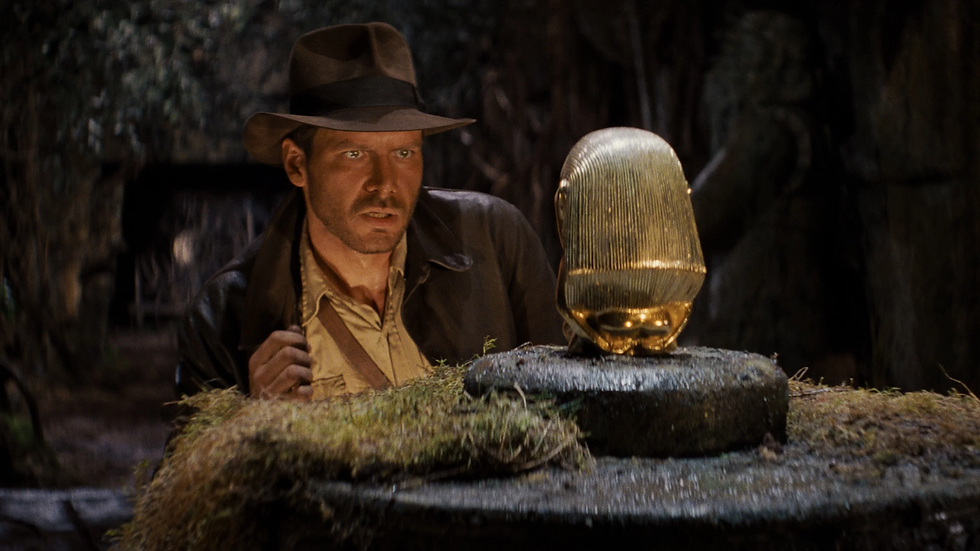
Plot Summary via Letterboxd: When Dr. Indiana Jones – the tweed-suited professor who just happens to be a celebrated archaeologist – is hired by the government to locate the legendary Ark of the Covenant, he finds himself up against the entire Nazi regime.
Raiders of the Lost Ark started another franchise for Harrison Ford, as well as putting screenwriter, Lawrence Kasdan, in the market as one of the most in-demand writers in Hollywood. There's not a lot of new material I can tell you that hasn't been said before. Whether it's the incredible stunt work onscreen, the memorable score by John Williams, or even the performances by the ensemble, they're all first-rate. If I do have anything to add for my recent rewatch, I have to praise something the first few installments got right that Dial of Destiny didn't and that's the cinematography.
Not only is the look here stunning to witness, but the film uses a lot of wide shots to geographically show where everyone is in within the scenes. Spielberg's insistence of using longer takes is effective, as it allows us to breathe in the moment alongside our characters. With something like Dial of Destiny, you're not able to breathe in each shot as they're cut together like a modern action film and hardly use any wide shots. Even if some of the sequels have middling results, Raiders of the Lost Ark is still a terrific adventure flick to witness.
2) Saving Private Ryan (1998)

Plot Summary via Letterboxd: As U.S. troops storm the beaches of Normandy, three brothers lie dead on the battlefield, with a fourth trapped behind enemy lines. Ranger captain John Miller and seven men are tasked with penetrating German-held territory and bringing the boy home.
Saving Private Ryan takes on a more gritter take of the war films we’d usually see from the old Hollywood era of John Wayne. I was blown away by just how graphic and impactful the action sequences were, including the opening Omaha Beach sequence which goes on for roughly 25 minutes. Usually war films (especially ones that would come out after this) would glorify the consequences of these young, brave men getting shot for God and country without allowing us to know who these people are. With this, Steven Spielberg does a terrific job making the audience care about these characters, so that when they do die you feel bad for them.
I especially appreciate how little of a score there is in the set pieces, as everyone making the film must’ve realized how impactful the story was without bombarding the film with one. Instead, the crew relies on the use of sound and film editing to make the scenes have a punch to them that’ll make the audience remember the film long after it’s over. Even the cinematography by Janusz Kamiński is incredible, as it feels more like a documentary at times than it does in a fictional film with its sporadic and uncoordinated feel to the camera movements and the way actors are blocked in every scene. It’s a terrific film that for better or for worse is a big influential film for future war movies, as none of them came close to being this great.
1) Schindler's List (1993)

Plot Summary via Letterboxd: The true story of how businessman Oskar Schindler saved over a thousand Jewish lives from the Nazis while they worked as slaves in his factory during World War II.
Winner of seven Academy Awards including Best Picture and Best Director, Schindler's List is an incredible film that easily showcases some of his most mature work he's done. However, out of all the films Steven's done, this one feels different to me. Something like Jaws or Close Encounters of the Third Kind are films that feel fictional but not because their situations are unlikely to happen in reality. Their stories are told in a way that makes the audience feel comfortable with its Hollywood-like style to its filmmaking, even if the characters are in peril of getting killed by sharks or aliens.
With this film, I appreciate Steven making this like a documentary as you sit through such grim situations. In my opinion, it stands out as his best film because it shows the horrors of what the Holocaust was like without the story relying on the director's whimsy approach he puts in some of his films. Instead, he lets the audience sit through horrific sequences, such as witnessing Jewish prisoners being shot at point blank or having Amon Göth brutalize his Jewish maid; all without any hopeful music to beat the audience over the head on how much better the lives of these prisoners will be once Oskar saves them.
The film is filled with terrific performances by Liam Neeson and Ralph Fiennes, who absolutely deserved their Oscar nominations; Ben Kingsley also does such a great job playing Schindler's accountant, Itzhak Stern. I also love the friendship that builds throughout with Schindler and Itzhak that genuinely makes you care about these two characters despite their backgrounds. And much like Saving Private Ryan, I want to credit cinematographer, Janusz Kamiński, for shooting this on black-and-white photography as it makes the film even more like a documentary rather than a sanatized, Hollywood production. Schindler's List is an important film to watch and Steven's best film he's made. It may not be something you can throw on every once in a while like his other films, but it's one that stays with you long after the credits are over.
Conclusion

Unlike a lot of other filmmakers we've had past and present, Steven Spielberg is one of the few I can think of that has a fair amount of films everyone enjoys. In fact, I haven't really found a lot of people that don't care for his work, which is rare for a filmmaker that's made an impact on cinema for over 50 years. Either way, he's a one-of-a-kind storyteller that's still inspiring more future filmmakers. Regardless how Disclosure Day does at the box-office over the Summer or what kind of buzz it can generate for the upcoming award season, at least we have someone as talented as Steven still doing what he does best: entertain us with his stories.
He's a filmmaker that'll keep showing us the stuff that dreams are made of.


Comments