


ROSEBUSH PRUNING Review

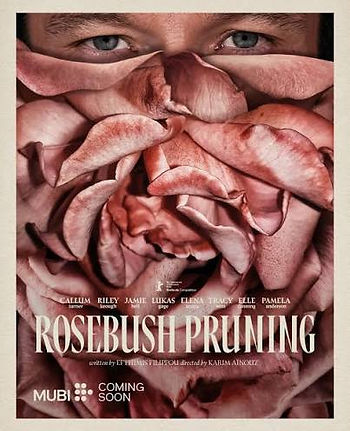
In a luxurious villa in Catalonia, four wealthy American siblings live with their blind father, largely isolated from the outside world. Their already complicated family dynamic begins to unravel when Jack (Jamie Bell), the eldest son, announces that he plans to move out and live with his girlfriend, Martha (Elle Fanning). As Martha becomes more involved with the family, tensions between the siblings begin to rise, while Ed (Callum Turner) becomes increasingly fixated on the mysterious death of their mother. The more time they spend together, the more their dysfunctional family dynamic starts to reveal itself. Eventually, the secrets and resentments that have been buried within the family begin to come to the surface.
One of the things that works best about Rosebush Pruning is its visual style. As a cross-cultural production, Brazilian director Karim Aïnouz teams up with Greek screenwriter Efthimis Filippou, known for his collaborations with Yorgos Lanthimos, and a British and American cast to tell a story set in Catalonia, Spain. This works really well in the film’s favor, creating a fascinating mix of influences that gives the movie a unique cinematic language. The setting is gorgeous, and the film does a great job of capturing both the natural beauty of Catalonia and the lavish interiors of the family’s homes. There are also some trippy moments and strange cuts throughout that are really fun to watch and add to the film’s overall mystique.
The performances are another strength, with Jamie Bell and Elle Fanning standing out among the ensemble. Fanning has a particularly difficult role, as Martha is one of the more vulnerable and emotionally honest characters in the film, and she handles that side of the character really well. Bell also brings a strong presence to Jack, making him one of the more engaging members of this dysfunctional family. While none of the performances are particularly show-stopping, the cast is generally solid and gives the film a strong foundation to work with.
This film is inevitably going to draw a lot of comparisons to Saltburn, and rightfully so. Both films prioritize shock value and use society’s general hatred of the extremely wealthy as a crutch. The problem is that Rosebush Pruning really doesn’t have anything new to say about class or the divide between the wealthy and everyone else. There isn’t much nuance to its portrayal of this family, either. They are presented as being so comically awful that it becomes difficult to really buy into them as actual people. Maybe it’s true that plenty of wealthy elites are genuinely terrible, but I have a hard time believing that all of them would be quite this cartoonishly depraved, especially when the film starts getting into the family’s inter-familial erotic relationships. Instead of making these characters feel more disturbing, it often just made me question whether any of this was supposed to be taken seriously.

This also makes it difficult to become emotionally invested in what is happening. There are certainly interesting ideas buried within the story, particularly surrounding Ed’s obsession with his mother’s death and the resentment that exists between the siblings, but the film never develops these ideas enough for them to really land. Instead, the characters mostly feel like vehicles for the next strange or disturbing thing to happen. Martha is probably the closest the film gets to giving us someone to genuinely connect with, which is part of why Elle Fanning’s performance works so well. Unfortunately, the rest of the family is so deliberately exaggerated that I found myself becoming more interested in watching the film than actually caring about what happened to these people.
I also think the film sometimes gets a little too caught up in its own absurdity. There is clearly an influence from Efthimis Filippou’s collaborations with Yorgos Lanthimos, particularly in the way the characters speak and interact with one another. There is a very strange, almost detached quality to the family that can be entertaining, and some of the film’s darker comedic moments genuinely worked for me. The problem is that the further the film pushes these characters into absurdity, the harder it becomes to see them as anything beyond caricatures. Too often, the weirdness feels like the point rather than a means of getting at something deeper.
Ultimately, I think Rosebush Pruning is a film that I wanted to like more than I actually did. There is a lot here that I found interesting, from its gorgeous visual style to the strong performances and some genuinely bizarre moments that I couldn’t help but enjoy. But the more the film leaned into its outrageousness, the more I felt like it was sacrificing its characters and ideas for the sake of shock. I don’t necessarily need a movie like this to be realistic or subtle, but I do need to feel like there is something underneath all of the provocation. Rosebush Pruning has plenty of style and some interesting ideas, but ultimately, I found the experience more fascinating than meaningful.
🍿 SCORE = 58 / 100


Comments